
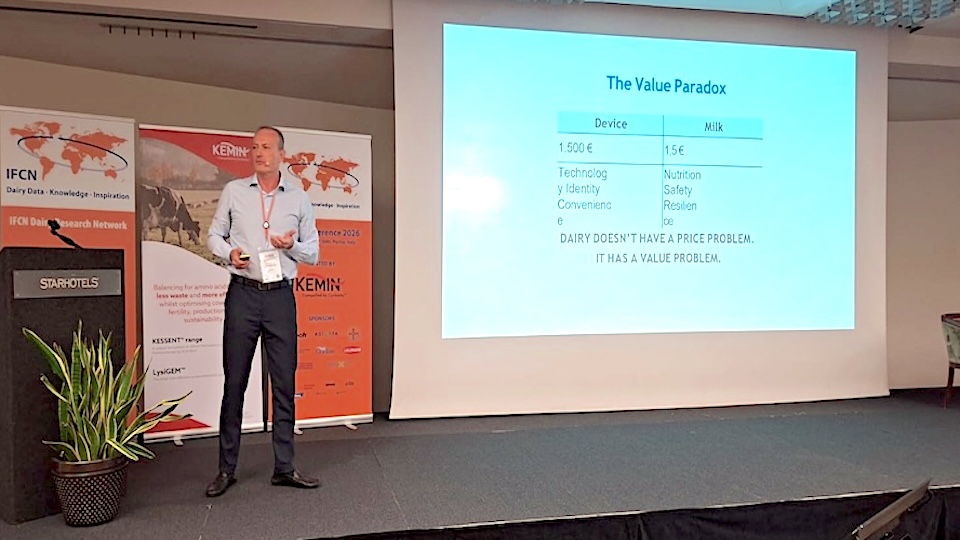
IFCN Conference: Dairy Has a Value Problem
At the IFCN Dairy Conference 2026 in Parma, I challenged the dairy industry to rethink how it defines and communicates its value. My intervention moved from the changing consumer and AI-driven cognitive outsourcing to food resilience, the growing strategic importance of high-quality protein, and a principle I call Protein Coexistence.
The central argument: dairy should move from defending individual products to explaining its broader contribution to nutrition, resilience, and the global protein system.
Talking Points
- Dairy may have a value problem, not a price problem.
- More information does not necessarily mean better understanding.
- AI is becoming part of our cognitive infrastructure.
- Dairy must move from litres to food resilience.
- The nutrition challenge is shifting from calories to quality.
- The future is Protein Coexistence, not protein war.
- Dairy needs to move from defence to leadership.
The Dairy Value Gap
I started with a simple provocation. We routinely spend €1,500 on a smartphone, thousands on a handbag or hundreds every year on entertainment. We recognise technology, convenience, design, identity and experience as sources of value. Yet a small increase in the price of a litre of milk is immediately noticed.
This is not an argument that milk should cost more. It raises a different question: why is the value behind dairy so difficult to see? Behind a simple carton of milk lies a sophisticated system of farming, animal health, genetics, science, technology, processing, food safety, refrigeration, logistics, trade, and human expertise. But at the supermarket shelf, all that complexity is compressed into a product and a price. That is the Dairy Value Gap:
Value created → high Value communicated → fragmented Value perceived → incomplete Price sensitivity → high
Dairy is extremely effective at creating value. It needs to become better at making that value understandable.
The Most Informed – and Confused – Consumer in History
The challenge has become more difficult because consumers have changed. They face questions about price, nutrition, protein, fat, lactose, sustainability, emissions, animal welfare, processing, and alternatives. They have access to more food information than any previous generation.
But more information does not necessarily produce better understanding. Information overload encourages shortcuts. Consumers increasingly depend on intermediaries to search, filter, and simplify complexity. And a new intermediary is rapidly entering that process: artificial intelligence.
What Does AI Understand About Dairy?
AI can be an extraordinary tool for empowerment. It can make scientific knowledge more accessible, compare alternatives, and help individuals make choices that better reflect their needs. But it also encourages cognitive offloading. We increasingly delegate searching, comparing, filtering, and synthesising information to machines.
I describe the broader phenomenon as cognitive outsourcing. This matters for dairy because consumers may increasingly stop searching through multiple sources and simply ask an AI:
Is dairy healthy? Is milk good for my children? What is the best protein after exercise? Milk or a plant-based alternative?
READ MY NEWS POLICY GUIDELINE ON ULTRA-PROCESSED FOODS
AI therefore becomes part of our cognitive infrastructure: part of the system through which information becomes understanding. For decades, industries competed for shelf space. Then they competed for attention.
Increasingly, they will compete for understanding. The strategic question is no longer only: What do consumers think about dairy? It is also: What does AI understand about dairy?
From Litres to Food Resilience
Dairy has traditionally been very good at answering criticism. Questions about emissions produce emissions data. Questions about nutrition produce nutritional evidence. Questions about animal welfare generate evidence about welfare improvements. These responses matter. But there is a strategic weakness: someone else has already framed the question. Dairy needs to define proactively what it contributes.
Energy provides an interesting analogy. The sector learned to speak not only about barrels, gas, or kilowatts, but about security, resilience, and strategic autonomy. Dairy needs a similar shift:
Litres → nutrition Volume → value Commodity → strategic capacity Efficiency → resilience
Dairy is not simply a commodity. It is part of the infrastructure through which societies provide nutrition.
The Protein Moment
This becomes particularly important as the global nutrition challenge evolves.
The question is no longer simply whether we can produce enough calories. Demographic change, ageing, urbanisation and changing lifestyles increase the importance of high-quality nutrition.
DO NOT MISS MY TALK IN WARSAW ON PERSONALIZED PREVENTION
Protein matters, but grams alone are not enough. Protein quality, essential amino acids, digestibility, nutrient density, affordability and accessibility all matter. Dairy has distinctive strengths across these dimensions and an expanding role in areas ranging from traditional foods to whey and casein, specialised nutrition, active lifestyles and healthy ageing.
The future value of dairy may therefore increasingly be measured not only by volume produced, but by nutrition delivered.
Protein Coexistence, Not Protein War
Recognising the strategic contribution of dairy does not require another food war.
The binary opposition between animal and plant proteins is too simplistic. Different protein sources have different nutritional and functional characteristics and operate across different cultures, geographies, income levels and dietary needs.
The future food system needs diversity. I call this Protein Coexistence. Animal proteins, plant proteins and emerging technologies can compete and innovate while also complementing one another.
Competition → innovation Diversity → resilience Choice → empowerment
Dairy does not need to win a protein war. It needs to demonstrate and continuously improve its distinctive contribution within a broader protein ecosystem.
From Defence to Leadership
The opportunity for dairy is ultimately one of positioning. The sector should spend less time explaining what it is not and more time demonstrating what it contributes. That means moving:
from price to value; from volume to nutrition; from commodity to resilience; from information to understanding; from defence to leadership.
The data can tell us where dairy stands today. Leadership will determine how dairy is understood tomorrow. Don’t just produce milk. Make the world understand why it matters.
