
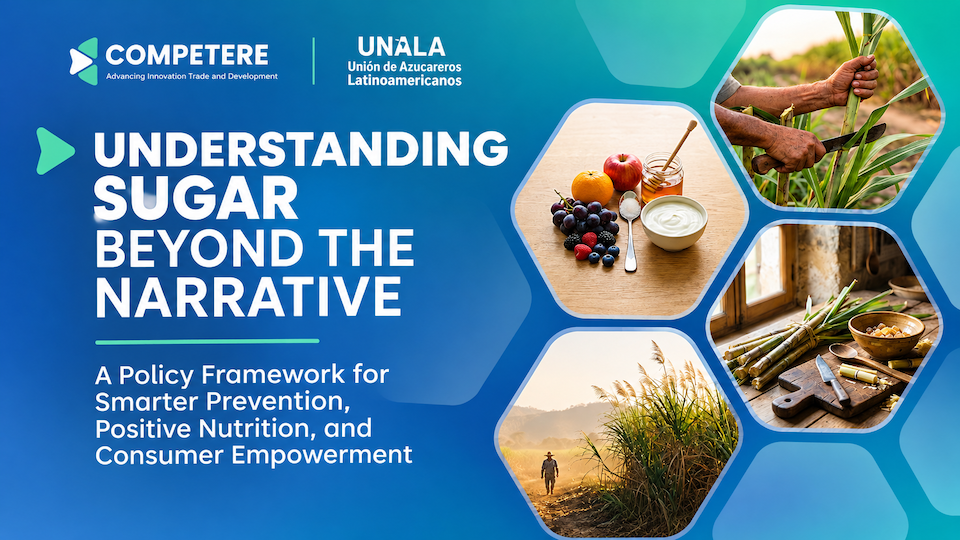
Sugar is not the Enemy. Bad Policy is. New Paper Out Now
With Competere, we have launched Understanding Sugar Beyond the Narrative, a new policy paper challenging the oversimplification of nutrition and questioning whether today’s most popular public health interventions actually deliver better health.
Check out the full paper here.
For a quick read, check out the Executive Brief here.
WHAT HAPPENS Our new paper is out today. Our message is simple: Sugar is not poison. And taxing it is not a public health strategy.
- Sugar is not the problem. Excess and imbalance are.
Sugar can be part of a healthy, balanced diet. What matters is how much we consume, how often, in which foods, and within what overall lifestyle.
- Yet public debate increasingly treats sugar as the enemy behind obesity, diabetes, and other chronic diseases.
Science tells a more complex story.
DO NOT MISS MY TALK ON SCIENCE AND SIMPLIFICATION
WHAT MAKES OUR STUDY DIFFERENT? We wanted to go beyond another debate about whether sugar is good or bad.Our paper offers policymakers, journalists, and citizens a practical framework built around four questions:
- UNDERSTAND: What is sugar, how does our body process it, and what does science actually tell us?
- QUESTION: How do scientific findings become simplified narratives and political interventions?
- ASSESS: What do sugar taxes, warning labels, and reformulation actually achieve? What are their unintended consequences?
- RETHINK: How can we move from restrictive policies toward positive nutrition, education, physical activity, and consumer empowerment?
CHECK IT OUT: FOOD SECURITY IS NATIONAL SECURITY
The study combines scientific evidence, international policy experiences, critical assessment of existing interventions, and practical policy recommendations.
- It also includes an accessible FAQ and a Policy Snapshot designed to make complex evidence useful for decision-makers.
TAXING SUGAR IS EASY Improving health is harder. Our analysis finds that sugar taxes can influence prices, purchasing behavior, and product reformulation.
But changing what people buy is not the same as demonstrating that people become healthier.
- And every intervention has costs, trade-offs, and potentially unintended consequences.
- We need to assess policies by their real outcomes, not just their intentions.
FROM FEAR TO EMPOWERMENT The alternative is not inaction. It is smarter prevention.
DO NOT MISS MY TALK IN COPENHAGEN: THE MEDITERRANEAN WAY
- Better nutrition education. More physical activity. Greater food literacy. Balanced diets. Informed choices.
And policies that empower citizens rather than treating them as passive subjects of regulation.
We don’t need a war on sugar. We need a better strategy for health.
READ THE STUDY
📘 DOWNLOAD THE FULL PAPER
📄 DOWNLOAD THE EXECUTIVE BRIEF
