
Rethinking the Mediterranean Diet and the Future of Prevention – Copenhagen
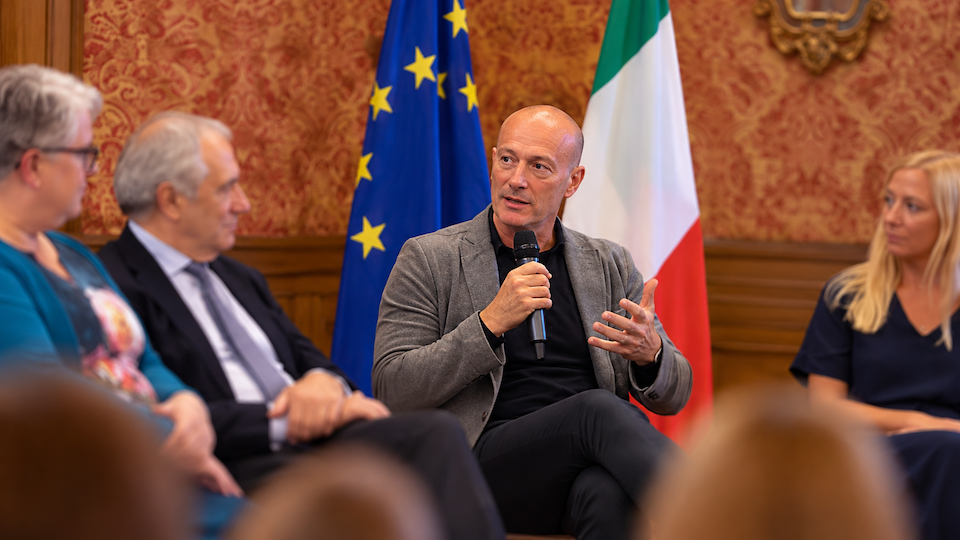
At the international conference Positive Nutrition: Mediterranean and Nordic Dietary Models – Innovation and Sustainability for Future Food Systems, hosted by the Embassy of Italy in Denmark and the Nordic Council of Ministers in Copenhagen, I challenged conventional approaches to nutrition and public health.
My argument was simple: the Mediterranean Diet is a method, not a menu. Rooted in the ancient Greek concept of diaita, it offers a broader philosophy of healthy living based on moderation, balance, movement, and social well-being.
This perspective raises important questions about contemporary nutrition policies, their excessive reliance on food classifications, and the opportunities offered by education, scientific innovation, and personalized prevention.
Three Talking Points
- The Mediterranean Diet Is a Method, Not a Menu. Its value lies in moderation, dietary variety, physical activity, and social well-being. These principles can evolve across cultures and individual lifestyles.
- Changing What People Buy Does Not Necessarily Improve How They Live. Nutri-Score, processing-based classifications, sugar taxes, and product reformulation may influence consumer behavior, but their contribution to long-term health must be assessed within the broader determinants of prevention.
- The Future of Prevention Begins with Empowerment. Education, precision nutrition, artificial intelligence, and wearable technologies can help individuals understand their needs, exercise judgment, and develop healthier lifestyles.
I hate traffic lights. I love roundabouts.
That was the provocation I brought to Copenhagen during the international conference Positive Nutrition: Mediterranean and Nordic Dietary Models, organized by the Embassy of Italy in Denmark and the Nordic Council of Ministers.
What do traffic lights and roundabouts have to do with nutrition?
Quite a lot, particularly when we consider how contemporary public health policies approach individual choices.
A traffic light tells us when to stop and when to go. A roundabout operates through shared rules, but requires individuals to observe, evaluate, interact, and make decisions.
DO NOT MISS MY ANALYSIS: WILL AI HELP YOU CHOOSE YOUR VOTE?
These two systems illustrate different philosophies of prevention: one relies primarily on standardized instructions, while the other places greater emphasis on individual judgment and responsibility.
Rediscovering the Mediterranean Method
The Mediterranean Diet is frequently celebrated as a collection of traditional foods and recipes. Yet this interpretation overlooks its deeper cultural foundations.
Its intellectual roots can be traced to the ancient Greek concept of diaita: a way of life encompassing nutrition, physical activity, rest, and daily habits.
The Mediterranean Diet, as scientifically described in the twentieth century, is not an unchanged continuation of ancient dietary practices. Its broader philosophy nevertheless resonates with this understanding of health.
WATCH MY INTERVIEW ON RADIO ROMA: FREEDOM AND RESPONSIBILITY
Moderation is the method. Balance is the goal. Prevention is the purpose.
This perspective becomes particularly relevant when we consider the Mediterranean paradox: the growing burden of overweight, obesity, and chronic diseases in societies historically associated with healthy dietary traditions.
Food has become more abundant, accessible, and convenient, while technological progress has reduced the physical effort required in everyday life. Social habits have also changed.
These transformations reflect remarkable achievements in human development. They also create new challenges for maintaining healthier lifestyles.
The Mediterranean method reminds us that nutrition, movement, and psychological and social well-being are interconnected.
Beyond Food Classifications
Much of today’s regulatory debate focuses on individual food products: their nutritional composition, ingredients, degree of processing, and classification as healthier or less healthy.
Instruments such as Nutri-Score, warning labels, sugar taxes, and processing-based classifications pursue different objectives and may influence purchasing decisions or product composition.
DO NOT MISS MY TALK AT THE EUROPEAN DAIRY ASSOCIATION CONFERENCE IN BRATISLAVA
But changing what people buy is not necessarily the same as improving how people live.
Obesity and non-communicable diseases develop through complex interactions among biological, behavioral, and environmental factors.
Food matters enormously. So do physical activity, sleep, stress, living conditions, and individual differences.
Nutrition policy should therefore be understood as one component of a broader prevention strategy.
The effectiveness of public interventions must be assessed accordingly, considering not only purchasing behavior but also dietary outcomes, long-term health, costs, and unintended consequences.
Why Roundabouts Matter
My preference for roundabouts reflects a simple conviction: effective prevention requires informed and capable individuals.
Roundabouts have rules. They are not an invitation to ignore them. But they also rely on the ability of people to exercise judgment within a shared framework.
Similarly, public policy has an essential role in providing reliable information, protecting consumers, and creating conditions that support healthier choices.
Education must become a central investment, beginning in schools and continuing throughout life. Nutrition, movement, energy balance, and lifestyle should also receive greater attention in medical training.
DO NOT MISS MY TALK AT THE EUROPEAN PARLIAMENT
Scientific and technological innovation offers new opportunities. Precision nutrition, artificial intelligence, and wearable devices can help us better understand individual differences and support more personalized approaches to prevention.
Yet technology must remain an instrument of empowerment. Replacing standardized nutritional labels with algorithms that continuously prescribe our behavior would simply create a new generation of traffic lights.
Prevention should improve quality of life, not transform everyday living into a permanent medical exercise.
The Future of Prevention Begins with the Individual
The discussion in Copenhagen highlighted the value of comparing Mediterranean and Nordic dietary traditions.
Their foods, environments, and cultural practices differ, but both can contribute to a broader understanding of healthy living.
There is no need to impose a single dietary model on everyone. The challenge is to identify principles that can be adapted to different individuals and circumstances.
The Mediterranean Diet offers a particularly valuable lesson: health is shaped by the way we live, and maintaining it requires knowledge, moderation, and the capacity to make informed decisions.
The future of prevention lies in empowering individuals to find their own balance and take responsibility for their health.
