
Science, Simplicity and the Danger of Oversimplification – Rome
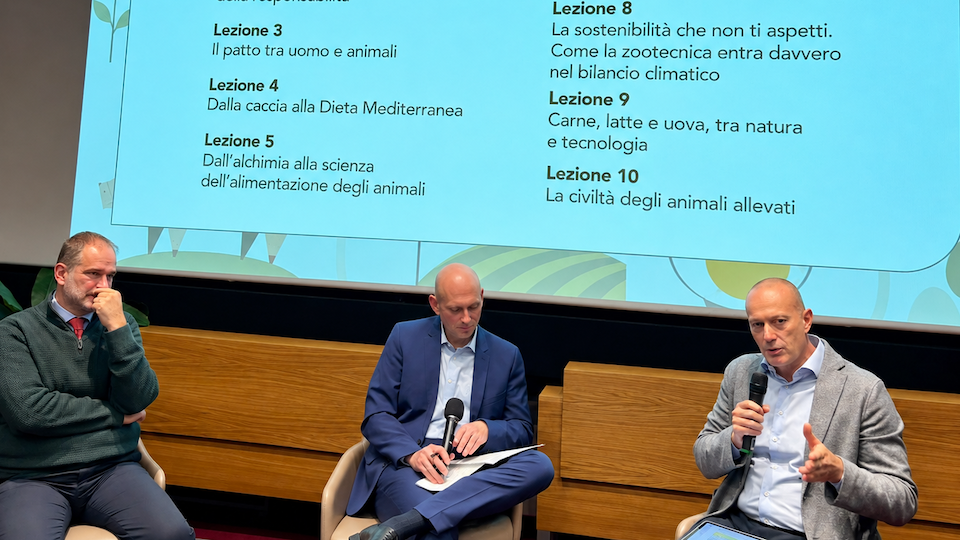
I participated in Rome in the presentation of Professor Giuseppe Pulina’s new book, Dieci brevi lezioni di zootecnica (Ten Short Lessons in Animal Science), published by Franco Angeli, which introduces a Manifesto for 21st-century Animal Science.
During my intervention, I explored a challenge extending far beyond livestock farming: how can we make scientific knowledge accessible without oversimplifying reality?
Pulina’s book offers an important contribution to this debate, demonstrating why understanding complex biological systems requires connecting scientific disciplines, evidence, and perspectives.
See the full video coverage by ANSA
Talking Points
- Simplicity requires intellectual effort. Simplifying scientific knowledge means making complexity understandable without losing essential relationships. Oversimplification removes precisely what matters.
- Science cannot be reduced to slogans. Biological systems involve interconnected variables. Binary narratives such as intensive versus extensive farming or natural versus artificial rarely capture their complexity.
- The medium shapes the message. Digital platforms have democratised access to information, but their incentives often favour speed, emotion, and polarisation over scientific understanding.
- Animal science requires multidisciplinary thinking. Pulina represents a Renaissance approach to science, connecting biology, genetics, nutrition, economics, ethics, and technology through scientific reasoning.
- Scientific understanding empowers individual choice. The purpose of science communication should be to strengthen critical thinking, personal agency, and informed decision-making rather than provide ready-made judgements.
Science and simplification
At the presentation of Giuseppe Pulina’s Dieci brevi lezioni di zootecnica in Rome, I focused on a fundamental challenge facing contemporary science communication: the growing confusion between simplicity and oversimplification.
Simplicity is an intellectual achievement. Oversimplification is often an intellectual shortcut.
Making scientific knowledge accessible requires identifying essential information, explaining relationships, and translating complex concepts into understandable language. Oversimplification, by contrast, removes the context and interdependencies necessary to interpret scientific evidence correctly.
This distinction has significant implications for public debate and policymaking, particularly in areas such as nutrition, agriculture, animal welfare, and environmental sustainability.
The Medium is the message
As Marshall McLuhan observed, the medium is the message. The development of social media, digital platforms, and artificial intelligence has transformed how scientific information is produced, distributed, and consumed.
These technologies offer extraordinary opportunities to democratise knowledge. However, communication systems that reward immediacy, emotional engagement, and polarisation can also encourage reductive narratives. Animal farming illustrates this problem particularly well.
DO NOT MISS MY TALK IN COPENHAGEN: THE MEDITERRANEAN WAY
Public discussions frequently rely on binary classifications: intensive versus extensive farming, natural versus artificial production, sustainable versus unsustainable practices.
Yet the scientific assessment of livestock systems requires examining multiple interacting factors, including animal nutrition, genetics, health and welfare, resource efficiency, environmental impacts, technological innovation, and economic sustainability.
No single label can adequately represent all these dimensions.
Science is simple
Giuseppe Pulina’s book provides a valuable alternative to this fragmented understanding. I described him as a Renaissance-minded scientist because his approach connects disciplines that are too often treated separately.
Animal science is not simply about producing food. It is about understanding and managing complex relationships between humans, animals, biological systems, technology, and the environment.
This also raises an important question about the growing distance between modern society and livestock farming. As direct experience with farm animals declines, public perceptions may increasingly be shaped by emotional narratives, cultural representations, and simplified messages.
DO NOT MISS MY ANALYSIS: WILL AI HELP YOU CHOOSE YOUR VOTE?
Empathy towards animals is essential, but it cannot replace scientific knowledge.
The animal we imagine inspires emotion. The real animal demands responsibility.
Responsible animal farming requires scientific expertise, appropriate nutrition, veterinary care, disease prevention, animal welfare monitoring, and continuous innovation. It also requires transparency and a willingness to identify and address shortcomings.
Beyond the Tag
The challenge becomes particularly visible at the consumer level.
Behind a steak, a litre of milk, or an egg lies an intricate system of scientific knowledge, human ingenuity, biological relationships, and technological progress. Yet consumers are frequently invited to interpret these products through a price, a label, or a simplified judgement.
Information tools can support decisions, but information alone does not guarantee understanding. This is why I believe science communication should focus on education, critical thinking, and personal empowerment.
WATCH MY INTERVIEW ON RADIO ROMA: FREEDOM AND RESPONSIBILITY
Rather than replacing individual judgement with predetermined answers, scientific communication should help people understand evidence, recognise trade-offs, and make choices consistent with their needs and values.
Pulina’s book contributes to this objective by making animal science accessible without denying its complexity. It provides readers with scientific concepts and intellectual tools to ask better questions.
The broader lesson extends beyond animal science to nutrition policy, public health, environmental regulation, and technological innovation.
The purpose of simplification is not to remove complexity from reality. It is to give people the tools to navigate it.
Because the better we understand, the freer we are to choose.
