
Leave No Smallholder Behind: Making Sustainability Work in Practice
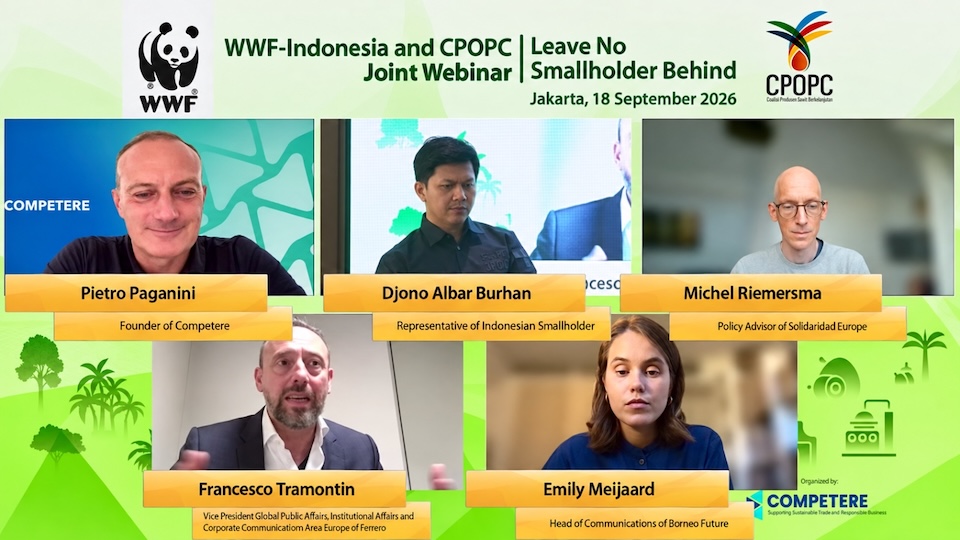
I moderated the CPOPC–WWF Indonesia webinar “Leave No Smallholder Behind”, held in the context of the new cooperation between the Council of Palm Oil Producing Countries (CPOPC) and WWF Indonesia.
The discussion brought together four complementary perspectives: scientific evidence, the direct experience of an Indonesian smallholder, the business and supply-chain perspective, and organisations working with farmers on the ground.
Our objective was practical: to understand how sustainability and traceability requirements — including the EU Deforestation Regulation (EUDR) – can strengthen palm oil supply chains without excluding smallholders from international markets.
The key question is increasingly clear: sustainability is not only about meeting standards. It is also about giving farmers the tools, investment, and capacity to demonstrate what they are already doing and continuously improve.
Speakers: Emily Meijard, Borneo Future – Francesco Tramontin, Ferrero – Michel Riemersma, Solidaridad – Djono Albar Burhan, Apkasindo.
Talking Points
- Smallholders are central to sustainable palm oil: they account for around 40% of global palm oil production and support millions of families and rural communities.
- A critical gap exists between being sustainable in practice and being able to demonstrate compliance through documentation, geolocation, traceability, and data.
- The palm oil supply chain and producing countries have already invested significantly in sustainability, certification, traceability and monitoring. The sector is among the commodities most advanced in preparing for EUDR compliance.
- Continuous improvement means recognising progress while continuing to address remaining environmental, social and economic challenges.
- Sustainability policies should not unintentionally exclude smallholders simply because larger producers are easier or cheaper to verify.
- Replacing palm oil with another commodity does not automatically solve sustainability problems. Impacts may simply be transferred elsewhere.
- Companies that remained committed to palm oil while investing in responsible sourcing, traceability and better practices demonstrate an alternative to commodity substitution.
- The costs and responsibilities of sustainability cannot fall on smallholders alone. Producing countries, Europe, companies, financial institutions and civil society all have a role.
- “Leave No Smallholder Behind” should move from a principle to a measurable implementation objective.
From Sustainability Ambition to Implementation
What if a farmer is sustainable — but cannot prove it? This apparently simple question captures one of the most important challenges facing sustainable commodity supply chains.
Smallholders account for around 40% of global palm oil production. Behind that number are millions of farmers, families and rural communities whose livelihoods are increasingly connected to international markets.
There can therefore be no resilient, sustainable and inclusive palm oil value chain without them. Yet sustainability regulation is becoming increasingly sophisticated. Farmers may be asked to provide documentation, geolocation data, traceability information and other evidence that requires technology, knowledge and financial resources.
The risk is a growing gap between sustainability on the ground and the capacity to demonstrate it. This distinction matters enormously.
READ MY ANALYSIS ON AI AND JOBS
The EUDR Is an Implementation Test
The EU Deforestation Regulation makes this challenge particularly visible.
The objective of deforestation-free supply chains is important. But implementation will determine whether regulation creates incentives for better practices or barriers that unintentionally exclude smaller producers.
The palm oil sector is not starting from zero. Producing countries, companies and other actors across the supply chain have invested significantly in certification, farmer registration, traceability, monitoring and preparation for the EUDR. These efforts and the progress already achieved should be recognised.
At the same time, much remains to be done. That is precisely what continuous improvement means: acknowledging progress while continuing to invest in better environmental, social and economic outcomes.
The challenge should increasingly move from asking whether farmers are sustainable to helping them demonstrate sustainability reliably and affordably.
DO NOT MISS MY TALK IN WARSAW: TIME TO PERSONALIZE PREVENTION?
Sustainability Cannot Mean Moving the Problem Elsewhere
There is another lesson worth emphasising. When sustainability problems emerge around a commodity, replacing that commodity with another ingredient can appear to be the easiest solution.
But substitution does not necessarily eliminate environmental or social impacts. It may simply transfer them to another crop, geography or supply chain.
A more demanding — and ultimately more constructive — approach is to improve the existing supply chain.
That means investing in better agricultural practices, traceability, farmer organisations, technology, training and responsible sourcing.
Some companies have followed precisely this path. Even under considerable public pressure and amid “palm oil free” campaigns, they remained committed to the commodity while investing in improving how it was produced and sourced.
Sustainability should reward this kind of persistence and investment rather than encourage companies simply to move the problem elsewhere.
DO NOT MISS THIS ANALYSIS: AI AND THE FUTURE OF WORK
From Demonisation to Evidence
Palm oil has also suffered from years of highly negative narratives.
Criticism is necessary where problems exist. Transparency and scrutiny help drive improvement.
But criticism becomes less useful when it turns into demonisation and ignores measurable progress.
A credible sustainability debate should be capable of doing two things simultaneously: identifying what still needs to improve and recognising what has already improved.
Facts, evidence and comparable sustainability criteria should replace campaigns based on simplified labels.
The objective is not to defend a commodity regardless of its impacts. It is to create the incentives that allow commodities and supply chains to improve.
READ IT AGAIN: WHAT KEEPS US STILL
Smallholders Cannot Finance the Transition Alone
There is finally a question of responsibility. Higher sustainability expectations require investment. Farm mapping, documentation, geolocation, digitalisation, training, certification and stronger farmer organisations all have costs. Those costs cannot fall disproportionately on farmers with the least capacity to absorb them.
Producing governments, European institutions, buyers, downstream companies, financial institutions, development partners and civil society therefore share responsibility for making the transition workable.
And where producing countries have already developed credible certification, registration and monitoring systems, the first question should be how these can be strengthened and connected to international requirements — rather than automatically creating parallel structures.
Smallholders themselves must also have a seat at the table. Policies designed without the people expected to implement them risk being technically sophisticated but practically unworkable.
Leave No Smallholder Behind
This is why “Leave No Smallholder Behind” should become more than an appealing sustainability principle.
It should become an implementation objective.
Success should ultimately be measurable: farmers remaining connected to sustainable international supply chains, better livelihoods, stronger productivity and resilience, credible traceability, reduced environmental impacts and continued investment in improvement.
The next phase of sustainable palm oil will not be built through demonisation or simply switching commodities.
It will be built through evidence, innovation, investment and cooperation.
The palm oil sector has already travelled a significant distance. The challenge now is to build on that progress — and make sure the people at the beginning of the supply chain travel with it.
